Showing posts with label chemistry. Show all posts

Saturday, February 25, 2023

Celebrating Black History Month: Alice Ball, black chemist who developed an early treatment for leprosy


Alice Augusta Ball, born July 24, 1882 in Seattle, Washington, is the first woman and first African-American woman to receive a Master's Degree from the University of Hawai'i.  She studied chemistry at the University of Washington where she earned a Bachelor's Degree in pharmaceutical chemistry in 1912.

Based on her work at the University of Hawai'i, Ball was contacted by Dr. Harry Hollimann, who requested her assistance for his research into a treatment of leprosy.  At the time, people diagnosed with leprosy were condemned to the Hawai'ian island Molokai, where they were expected to live out the rest of their lives. 

She developed a technique to isolate the antibiotic properties from chaulmoogra oil that could be injected into the body.  Her research led to successful treatments of leprosy, and people were able to be discharged from the hospital and return to their families.

She passed away from undetermined causes at 24 in December 1916.


Wednesday, November 9, 2022

Darmstadtium (Element 110) discovered/created 1994


Darmstadtium was first created November 9, 1994 at the Institute for Heavy Ion Research in Darmstadt, Germany.  Researches bombarded a lead (Pb-208) target with nickel (Ni-62) and created a single atom of the isotope darmstatdium-269. Using heavier isotopes of nickel, they created 9 atoms of Ds-271, confirmed by its decay and the daughter elements.

So far, 10 isotopes of darmstadtium have been reported, with Ds-281 being the most stable, with a half-life of about 12.7 seconds.  Due to such a short life span, chemical characteristics have not been determined.  However, Ds is extremely radioactive.  It is named after the city Darmstadt, where it was discovered.


Sunday, May 23, 2021

Celebrating Asian-American Heritage Month: Roger Tsien, awarded Nobel Prize in Chemistry 2008


Dr. Roger Tsien, born February 1, 1952 in New York City, New York, was awarded the Nobel prize in Chemistry in 2008.  A Chinese-American, Tsien suffered from asthma growing up and spent much time indoors, conducting chemistry experiments in his family's basement.

He won the Westinghouse Talent Search at 16.  He received his PhD in physiology in 1977 from Churchill College in Cambridge, England.

He shared the Nobel Prize in Chemistry with Osamu Shimomura and Martin Chalfie in 2008 for their wok for "the green fluorescent protein; discovery, expression and development".

He passed away in August 2016.

Saturday, May 1, 2021

Celebrating Asian-American Heritage Month: Charles Pedersen, first Korean to win a Nobel Prize


Charles Pedersen, born October 3, 1904 in Busan, Korea, is the first Korean to be awarded a Nobel Prize.  He shared the prize for chemistry with Donald J. Cram and Jean-Marie Lehn in 1987.  

While a chemist at DuPont, he developed a method for synthesizing crown ethers.

He passed away in October 1989.

Sunday, February 7, 2021

Celebrating Black History Month: Douglas Wilder, first African American governor of Virginia


Douglas Wilder, born on January 17, 1931 in Richmond, Virginia, became the first African-American governor of Virginia and the first since the Reconstruction era.  He served from January 1990 until January 1994.  

He is the grandson of slaves and graduated from Virginia Union University with a degree in chemistry in 1951.  He served in the US Army in the Vietnam War and was awarded the Bronze Star Medal for his actions at the Battle of Pork Chop Hill.


Saturday, May 30, 2020

Happy birthday, British astronaut Dr Helen Sharman!


Helen Sharman, born May 30, 1963 in Yorkshire, England, is the first British cosmonaut and first woman to visit the Mir space station.  She launched aboard Soyuz TM-12 in May 1991.  She was part of Project Juno, a cooperative project sponsored by private enterprises in Britain and by the Soviet government.  Her experiments were mainly life sciences, since she had a PhD in chemistry.  After about 7 days, she returned to Earth May 26 aboard Soyuz TM-11.


Friday, February 7, 2020

Celebrating Black History Month: Fritz Pollard & Bobby Marshall, first African-American athletes in the NFL

Bobby Marshall, Fritz Pollard

Frederick Douglass "Fritz" Pollard and Robert Wells "Bobby" Marshall became the first African-American athletes in what would become the National Football League in 1920.

Fritz Pollard went to Brown University and majored in chemistry(!).  He played halfback on Brown's football team (becoming the first black player for Brown), which went to the 1916 Rose Bowl.  He played pro football (running back) for the Akron Pros and became a co-head coach in 1921.  He also played for the Milwaukee Badgers, Hammond Pros, Gilberton Cadamounts, Union Club of Phoenixville and Providence Steam Rollers. 

In the 1930s, he founded his own professional football team, the Brown Bombers, but the Depression ended their run.  Pollard left football and went into other ventures.

Bobby Marshall played football for the University of Minnesota and went on to play professional for the Rock Island Independents, Minneapolis Marines and the Duluth Kelleys.

Saturday, February 9, 2019

Celebrating Black History Month: Lloyd Ferguson, first African-American to receive a doctorate in chemistry


Lloyd Noel Ferguson, born February 9, 1918, is the first African-American to receive a Ph.D. in chemistry from the University of California, Berkeley in 1943.  He took a faculty position at North Carolina Agricultural and Technical College and then moved to Howard University about two years later.  There he founded the doctoral program, the first at any black college.

In the 1960s, he became an advisory to the Food and Drug Administration.  In 1972, he became one of  the founders of  the National Organization for the Professional Advancement of Black Chemists and Chemical Engineers (NOBCChE).

He retired in 1986 and passed away in 2011.


Tuesday, February 5, 2019

Celebrating Black History Month: Lloyd Quarterman, Manhattan Project chemist


Lloyd Quarterman, born May 31, 1918 in Philadelphia, earned his Bachelor's Degree in chemistry from St. Augustine's College in Raleigh, North Carolina.  He was hired as chemist on the Manhattan Project during WWII with Albert Einstein and Enrico Fermi.  His chief responsibility was developing a system for purifying large quantities of hydrogen fluoride.  HF would  then be used to separate Uranium-235 for atomic bombs.  The U-235 accumulated was used to make Little Boy, the bomb dropped on Hiroshima.

He worked at Argonne National Laboratory in Chicago for 30 years. 

He passed away in July 1982.

Wednesday, January 2, 2019

2019 - International Year of the Periodic Table


2019 has been designated the International Year of the Periodic Table (IYPT2019), the 150th anniversary of Dmitry Mendeleev developing the Periodic Table of the Chemical Elements.  This is a partnership of the International Union of Pure and Applied Chemistry (IUPAC), International Union of Pure and Applied Physics (IUPAP), European Association for Chemical and Molecular Science (EuCheMS), the International Council for Science (ICSU), International Astronomical Union (IAU), and the International Union of History and Philosophy of Science and Technology (IUHPS).

They plan to have celebrations all over the globe.


https://www.iypt2019.org/about

Thursday, February 15, 2018

Celebrating Black History Month (and birthday) - Leland Melvin, Space Shuttle astronaut


Leland Melvin, born February 15, 1964 in Lynchburg, Virginia, is an African-American astronaut and a veteran of two space shuttle flights.  He graduated from the University of Richmond with a degree in Chemistry! 

He was recruited by the Detroit Lions in the 11th round of the 1986 NFL Draft as a wide receiver but pulled a hamstring during training and was released.

Melvin was selected as an astronaut in 1998 and flew on his first mission in February 2008 on Atlantis (STS-122) as mission specialist to the International Space Station.

His second was aboard Atlantis (STS-129) in November 2009 as mission specialist to the ISS.

He retired from NASA in February 2014.

Saturday, February 3, 2018

Celebrating Black History Month - Dr. Marie Maynard Daly, first African-American PhD in Chemistry


Marie Maynard Daly, born April 16, 1921 in Queens, New York, was the first African-American woman to earn a PhD in Chemistry awarded by Columbia University in 1947.  Her father, an immigrant from the British West Indies, attended Cornell University, planning to major in chemistry but was unable due to lack of funds. 

Marie majored in chemistry receiving her degree from Queens College in 1942.  She received her Master's degree from New York University and her PhD from Columbia University in 1947.  Her thesis was entitled "A Study of the Products Formed by the Action of Pancreatic Amylase on Corn Starch".

While teaching at Albert Einstein College of Medicine, she investigated the effects of cigarette smoke on lungs.  She passed away October 28, 2003 in New York City.


Thursday, December 21, 2017

Happy birthday, Space Shuttle astronaut Millie Hughes-Fulford!


Millie Hughes-Fulford, born December 21, 1945 in Mineral Wells, Texas, went into space aboard Space Shuttle Columbia (STS-40) in June 1991 as Payload Specialist.  The mission was the fifth Spacelab mission, the first dedicated to biology and the first time three women were on board.


Monday, December 11, 2017

Marie Curie awarded second Nobel Prize 1911


For over a century, the Nobel Prize committee has not only fallen for the greatest hoax of all time, science, but has continued to promulgate the lies and deceit from the evilest of evil people, scientists!  Just look at not one, but TWO incidents that happened on this day in history.  First of all, in 1911, Marie Curie was awarded her second(!) Nobel Prize, this time in chemistry.  A woman!  She is the only person, male or female, to win two prizes in different categories.  She won the first one with her husband in 1903 for Physics (but I'm sure he did most of the work). Don’t they know women don’t like or are not interested in math and science?  And just think of the dangers of radiation.  It would have been better if she had just left all that stuff alone.  If she had, we wouldn't be bothered with Godzilla or Spiderman!

Eleven years later, Neils Bohr was giving his acceptance speech for his Nobel Prize in Physics (just as liberal as chemistry, but at least it was a man this time!), when two of his contemporaries announced they had discovered the element hafnium.  What a stupid name. Supposedly it is the “Roman” name for Copenhagen.  Why couldn’t they have stayed with good ol' English name and called it Copenhagenium or Denmarkium? I have never even seen a hafnium?  Have you?


It’s all a conspiracy by the ultra-mega-platinum left-wing liberals to undermine our own education system with facts!  Conservatives don’t need no facts!

Monday, November 20, 2017

Book review - "Satan's Fire" by P. C. Doherty


P. C. Doherty’s ninth novel in his Hugh Corbett mystery series set in the early 1300’s England, involves the Knights of the Templar, and takes place just a few years before they were destroyed by greedy kings.  Doherty hints at the changing political climate in Europe as Philip IV in France and Edward I in England become jealous of the Templars’ wealth, since both kingdoms are strapped for cash.  Satan’s Fire opens with Edward managing to convince the very reluctant Templars to grant him a loan for his wars.

But strange events have occurred when the Knights of the Templar have been in the vicinity, such as an attempt on Philip’s life while hunting and ominous warnings pinned to doors.  The most bizarre of all are the reports of people killed in mysterious fires that seem to ignite spontaneously and have a mind of their own.

Edward summons his chief clerk Hugh Corbett, who longs to return to his manor in Leighton, to his wife and daughter.  Edward has received a warning and is fearful that someone is trying to assassinate him.  With extreme reluctance, Corbett plunges into the mystery of the strange fires (hence the title) and what the Templars are doing in Framlingham, their residence in England. 

The Templars aren’t shown in a favorable light and remain suspicious and aloof from Corbett and his manservant Ranulf and messenger Maltote.    But it becomes understandable when Doherty shows the shifting perceptions and the movements against their order from all sides.  They feel their existence is being threatened and have every right to believe so. There are certain splits among the Knights, which are causing tension which do not help their cause.

Corbett is one of the luckiest men on the planet since he manages to survive several attempts on his life in this book, but all the other victims were offed in one chance.  Hmm…

I like it when good ol’ chemistry is part of a novel, but not so much when it is used to kill.  Corbett finally discovers an ancient recipe founded by the Greeks centuries before after consulting old manuscripts.

On the downside once again, I read a book by Doherty and ask where is his editor? Does he even have one?  He commits several infractions that I was taught to avoid during my writing: use of passive voice, changes in point of view within one scene, etc.  Was all of it unnceccsary?

Tuesday, November 7, 2017

Remembering Gemini and Apollo astronaut Dick Gordon (1929-2017)


Astronaut Richard "Dick" Gordon, veteran of the Gemini and Apollo programs, passed away yesterday in California at the age of 88.  He was born October 5, 1929 in Seattle and received a Bachelor's Degree in Chemistry(!) in 1951 from the University of Washington.

His first flight was aboard Gemini XI with Pete Conrad.  They docked with the Agena Target Vehicle on the first orbit, only an hour and 34 minutes after launch, the first time attempting this maneuver.  Dick performed two EVAs for a total of 2 hours and 41 minutes.

His second and final flight was aboard Apollo 12, which was struck by lightning during takeoff, but made it to the moon safely.  Gordon orbited the moon in the Lunar Orbiter while Pete Conrad and Alan Bean walked on the moon.

He was assigned backup commander for Apollo 15 and was to walk on the moon during the Apollo 18 mission but that flight was cancelled.


Marie Curie, 2 x Nobel prize winner, born 1867


Marie Curie, born November 7, 1867 in Warsaw, Poland, is still the first woman to win a Nobel prize, the first person (and only woman) to win TWO Nobel prizes and the ONLY person to win a Nobel prize in two different categories!

Although she studied and worked in France, she remained loyal to her home country of Poland and named the first chemical element she discovered 'polonium' after it.

She shared the 1903 Nobel Prize in Physics with her husband Pierre for their work in radiation research. 

Her husband died in a tragic road accident in 1906, which devastated her, but the University of Paris where Pierre taught decided to offer his chair to Marie.  She accepted and became the first woman to teach at the university.

In 1911, she was awarded the Nobel Prize in Chemistry for her work in discovering and isolating the elements polonium and radium.

Due to her long exposure to radiation, Marie Curie contracted leukemia and passed away in 1934.


Thursday, October 5, 2017

Happy birthday, Gemini and Apollo astronaut Dick Gordon!

RichardFGordon.jpg

Richard "Dick" Gordon, born October 5, 1929 in Seattle, Washington, is one of only 24 men who have been to the moon.  He got a degree in Chemistry from the University of Washington and then went on to become a pilot in the military.

He was selected as an astronaut candidate in 1963 and was back-up pilot for Gemini VIII.  His first space flight was as pilot of Gemini XI, with Pete Conrad.

Gordon was Command Module Pilot for Apollo 12 in November 1969, with Alan Bean and Pete Conrad.  He remained in orbit above the moon taking pictures of possible future landing sites, while his comrades were strolling around the Ocean of Storms.

He was inducted into the Astronaut Hall of Fame March 19, 1993.

Wednesday, October 4, 2017

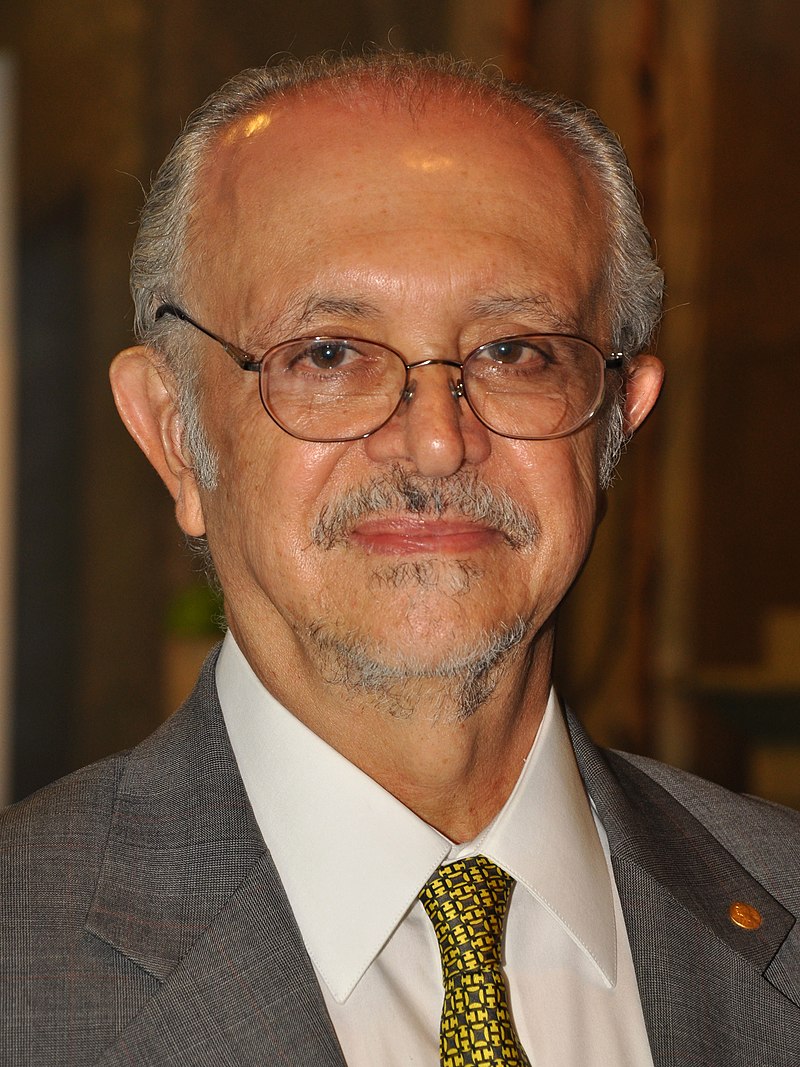
Celebrating National Hispanic Heritage Month - Mario Molina, first Mexican recipient of Noble Prize in Chemistry

Mario Molina 1c389 8387.jpg

Mario Molina, born in Mexico City, Mexico, is the first Mexican-born winner of the Nobel Prize in Chemistry.  He was the co-recipient in 1995 with Paul J. Crutzen and F. Sherwood Rowland for their discovery of the role of CFCs in ozone depletion.  Rowland and Molina published their discovery that chlorine atoms contribute to the destruction of ozone in Nature June 28, 1974.  They announced their findings to policy makers and news outlets to be sure people were aware.

Molina received the Presidential Medal of Freedom from President Obama on August 8, 2013.

President Obama said, "Mario Molina is a visionary chemist and environmental scientist. Born in Mexico, Dr. Molina came to America to pursue his graduate degree. He later earned the Nobel Prize in Chemistry for discovering how chlorofluorocarbons deplete the ozone layer. Dr. Molina is a professor at the University of California, San Diego; Director of the Mario Molina Center for Energy and Environment; and a member of the President’s Council of Advisors on Science and Technology."


Thursday, September 28, 2017

Celebrating National Hispanic Heritage Month - Dr. Luis Federico Leloir, first Argentinian to win Nobel Prize in Chemistry


Physician and biochemist Luis Federico Leloir was the first Argentinian to win the Nobel Prize in Chemistry.  He was given the prestigious award in 1970.

Despite hardships such as lack of financial support and less-than-state-of-the-art equipment, his research into sugar nucleotides, carbohydrate metabolism and renal hypertension has led to significant progress in understanding, diagnosing and treating galactosemia, a rare genetic disorder that effects an individual's ability to metabolize the sugar galactose properly.