Gemini XI, launched September 12, 1966, was the ninth manned spaceflight of NASA's Gemini program. Its crew consisted of Command Pilot Pete Conrad and Pilot Richard Gordon. During the flight, Gordon performed two EVAs, the first on September 13 for 33 minutes, and the second on September 14 for 2 hours 8 minutes.
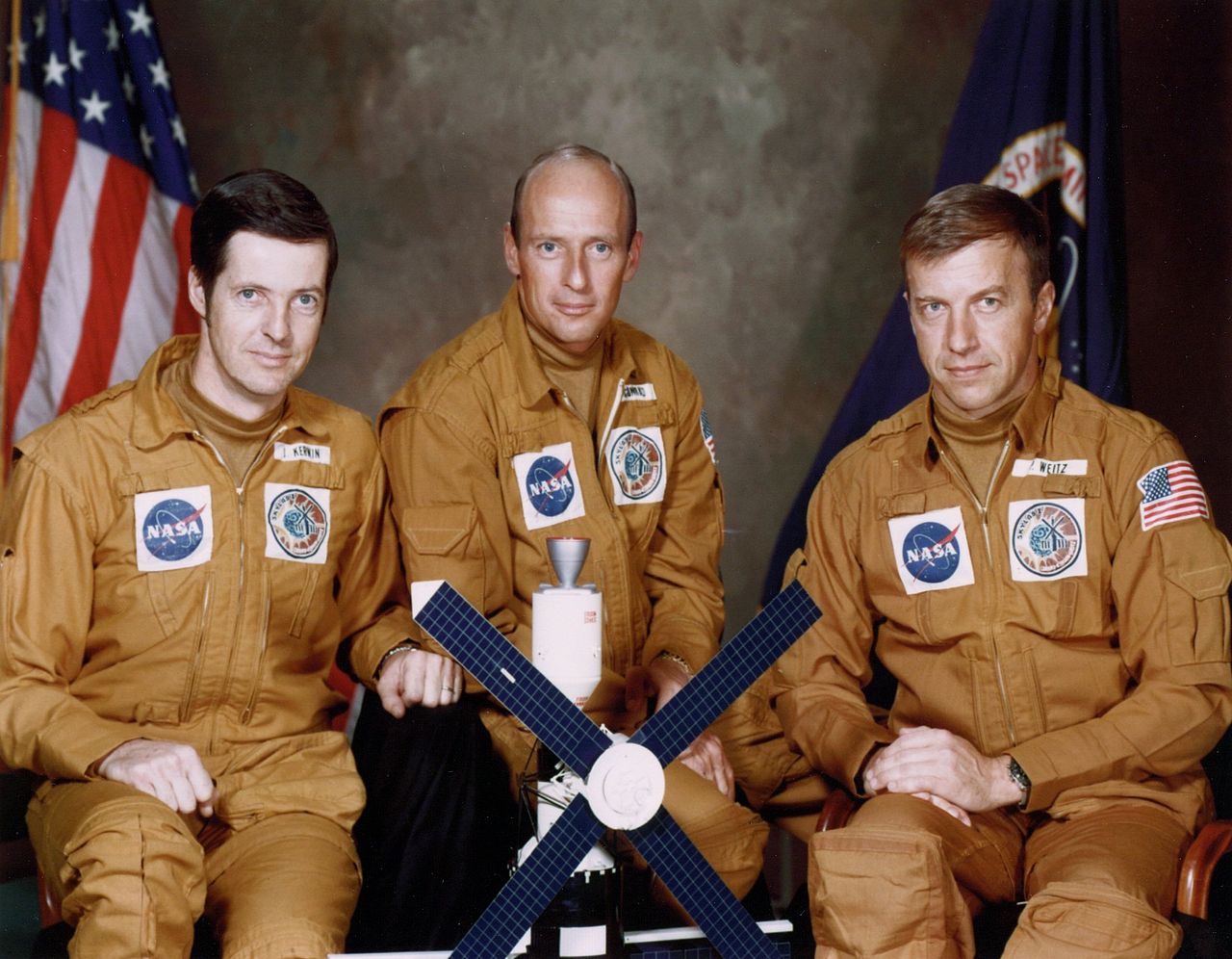
Joseph Kerwin, born February 19, 1932 in Oak Park, Illinois, went into space aboard Skylab 2. He received a Doctor of Medicine degree from Northwestern University Medical School in 1957 and became a naval flight surgeon in 1958.
NASA selected him as an astronaut in 1965, the first physician to selected for astronaut training. He launched aboard Skylab 2 as science pilot May 25, 1973 and returned to Earth June 22. He performed one EVA during the mission with fellow astronaut Pete Conrad lasting 3 hours, 25 minutes.
Alan Bean, born March 15, 1932 in Wheeler, Texas (that's in the panhandle just north of Shamrock), made his first trip into space aboard Apollo 12, becoming the fourth man to walk on the moon. NASA slected him as part of Astronaut Group 3 in 1963 and was assigned backup command pilot for Gemini X. He was assigned as backup crew for Apollo 9 when fellow astronaut Clifton Williams was killed when his T-38 jet trainer crashed.
Bean was launched on Apollo 12 in November 1969. The spacecraft was struck by lightning 36 seconds after launch and Bean restored telemetry by executing the "Flight, try SCE to 'Aux'" task. The lunar lander touched down in the Ocean of Storms within walking distance of the probe Surveyor 3, which had landed in April 1967. Bean and Pete Conrad removed parts of the probe to return to Earth for testing.
Bean was then assigned as commander of Skylab 3, with Owen Garriott and Jack Lousma. During the mission, Bean tested a prototype of the Manned Maneuvering Unit and performed an EVA outside Skylab.
He resigned from NASA in June 1981 to devote time to his painting.
Gordon Cooper, born March 6, 1927 in Shawnee, Oklahoma, was one of the first original astronauts chosen for Project Mercury, the first manned space program for the U.S. He flew on the final Mercury mission, Mercury-Atlas 9 (Faith 7) in May 1963. It was also the longest Mercury flight, and he was the first American to get to sleep during a mission, which lasted 34 hours. This flight marked the last time an American was to be launched on a solo orbital mission.
In August 1965, Cooper flew as Command Pilot of Gemini V with Pete Conrad. The mission lasted eight days, setting a new record, demonstrating that astronauts could survive in space for the time necessary to fly to the moon and back.
Cooper retired from NASA in 1970. He passed away in October 2004 from heart failure at age 77. He had contracted Parkinson's disease prior to his death.
Gemini VII, launched December 4, 1965, was fourth manned Gemini flight and the twelfth manned American space flight. Her crew, Frank Borman and James Lovell spent almost 14 days in space.
While in space they tried to solve problems that extended space flights would encounter such as stowage of waste, and nuntrition in space. Their new lightweight spacesuite became uncomfortable when worn for a long time (duh. Anything becomes uncomfortable after a while). Borman and Lovell took Pete Conrad's advice and took books to read.
That advice was well-taken since the last three days were "bad" according to Borman. They had finished their tests and the excitement of rendevouzing with Gemini VI was over. So they were doing little more than orbiting Earth and reading.
They splashed down December 18 and were recovered by the USS Wasp.
Astronaut Richard "Dick" Gordon, veteran of the Gemini and Apollo programs, passed away yesterday in California at the age of 88. He was born October 5, 1929 in Seattle and received a Bachelor's Degree in Chemistry(!) in 1951 from the University of Washington.
His first flight was aboard Gemini XI with Pete Conrad. They docked with the Agena Target Vehicle on the first orbit, only an hour and 34 minutes after launch, the first time attempting this maneuver. Dick performed two EVAs for a total of 2 hours and 41 minutes.
His second and final flight was aboard Apollo 12, which was struck by lightning during takeoff, but made it to the moon safely. Gordon orbited the moon in the Lunar Orbiter while Pete Conrad and Alan Bean walked on the moon.
He was assigned backup commander for Apollo 15 and was to walk on the moon during the Apollo 18 mission but that flight was cancelled.
Richard "Dick" Gordon, born October 5, 1929 in Seattle, Washington, is one of only 24 men who have been to the moon. He got a degree in Chemistry from the University of Washington and then went on to become a pilot in the military.
He was selected as an astronaut candidate in 1963 and was back-up pilot for Gemini VIII. His first space flight was as pilot of Gemini XI, with Pete Conrad.
Gordon was Command Module Pilot for Apollo 12 in November 1969, with Alan Bean and Pete Conrad. He remained in orbit above the moon taking pictures of possible future landing sites, while his comrades were strolling around the Ocean of Storms.
He was inducted into the Astronaut Hall of Fame March 19, 1993.
Gemini V, the third Gemini flight, the 11th manned American flight and the 19th spaceflight of all time, launched August 21, 1965 from Cape Kennedy in Florida. On board were the Command Pilot L. Gordon Cooper, Jr. and Pilot Charles "Pete" Conrad, Jr. They spent 7 days, 22 hours and 55 minutes in space, breaking the existing record for duration set by Vostok 5 in 1963.
Conrad and Cooper conducted medical experiments during the mission, but they did not have much of appetites. They averaged about 1000 cal/day although the intended daily intake was 2700cal. They also experienced dandruff as a significant problem, which was believed to be the results of very low ambient humidity in the cabin, causing their skin to become dry and flaky.
May 25, 1973, Commander Charles “Pete” Conrad, Jr., Science
Pilot Joseph P. Kerwin and Pilot Paul J. Weitz blasted off in Skylab 2, the
first manned mission to Skylab, which had been launched 11 days prior. The unmanned portion was damaged during its
May 14 launch. The micrometeorite shield
and one of its primary solar arrays tore loose during lift-off. The other primary solar array, which was to
keep the space station cool, was jammed.
Skylab crew had to train on repairing techniques before they
could enter the station. Upon reaching the station, Weitz performed an EVA to
unjam the solar array while Kerwin held onto his legs. This did not work so they tried a hard dock
to Skylab, but this failed as well, since the lathes did not work.
After a total of eight attempts, Weitz and
Kerwin performed another EVA and were successful at docking by disassembling
parts of the station’s mechanism. Then
they deployed a collapsible parasol through the scientific airlock as a sunshade
to cool the interior to livable levels.
For almost a month, the crew continued to make repairs to
Skylab, conduct medical experiments and gather scientific data. They performed a final EVA to fix the stuck
solar panel and increasing electrical power to the station.
They spent four weeks in space and returned to Earth June
22.
Commander Charles "Pete" Conrad, Jr.; Command Module Pilot Richard F. Gordon, Jr.; Lunar Module Pilot Alan L. Bean
Apollo 12, the second manned mission to the moon, launched November 14, 1969, but was struck by lightning twice during take-off. The crew had a narrow margin in which to launch to reach the moon, but bad weather threatened to delay take-off.
The first strike, 36 seconds after launch, triggered overload false alarms and took all three fuel cells off-line. It also shut off much of the Command Service Module instrumentations. The second strike, at 52 seconds knocked out the altitude indicator, but the Saturn V flew correctly.
Alan Bean remembered the Signal Conditioning Equipment (SCE) switch during training a year prior in which this problem had been simulated. the fuel cells went back on line and telemetry was restored. Teh mission continued and was completed successfully.
During the Apollo 12 mission in November 1969, Pete Conrad, born June 2, 1930, became the 3rd man to walk on the moon. He made his first EVA shortly after the lunar module landed in the Ocean of Storms, followed by Lunar Module Pilot Alan L. Bean. This was Conrad's third space flight having flown on Gemini 5 and Gemini 11. He later commanded the Skylab 2 mission.
When Pete stepped off the ladder onto the landing pad, he said:
"Whoopee! Man, that may have been a small one for Neil, but that's a long one for me."
He was referring to his shorter stature compared to Neil Armstrong. Pete made a $500 bet with Italian reporter Oriana Fallaci that he would say those words, proving that NASA does not write a script for the astronauts. He never collected on his bet, though.