STS-6 crew (L-R): Donald Peterson, Paul Weitz, Story Musgrave, Karol Bobko
Mission patch
Space Shuttle Challenger took off on her maiden voyage April 4, 1983. It was the first mission during which an EVA was conducted. Its crew consisted of Commander Paul Weitz, Pilot Karol Bobko, Story Musgrave and Donald Peterson. Weitz, the only non-rookie, had served as Pilot on Skylab 2.
Astronaut Paul Joseph Weitz, born July 25, 1932 in Erie, Pennsylvania, passed away yesterday October 23 in Flagstaff, Arizona from myelodysplastic syndrome. He was 85.
His first mission into space was aboard Skylab 2, the first manned mission to the space station from May-June 1973.
He was commander of STS-6, the maiden voyage of Challenger in April 1983.
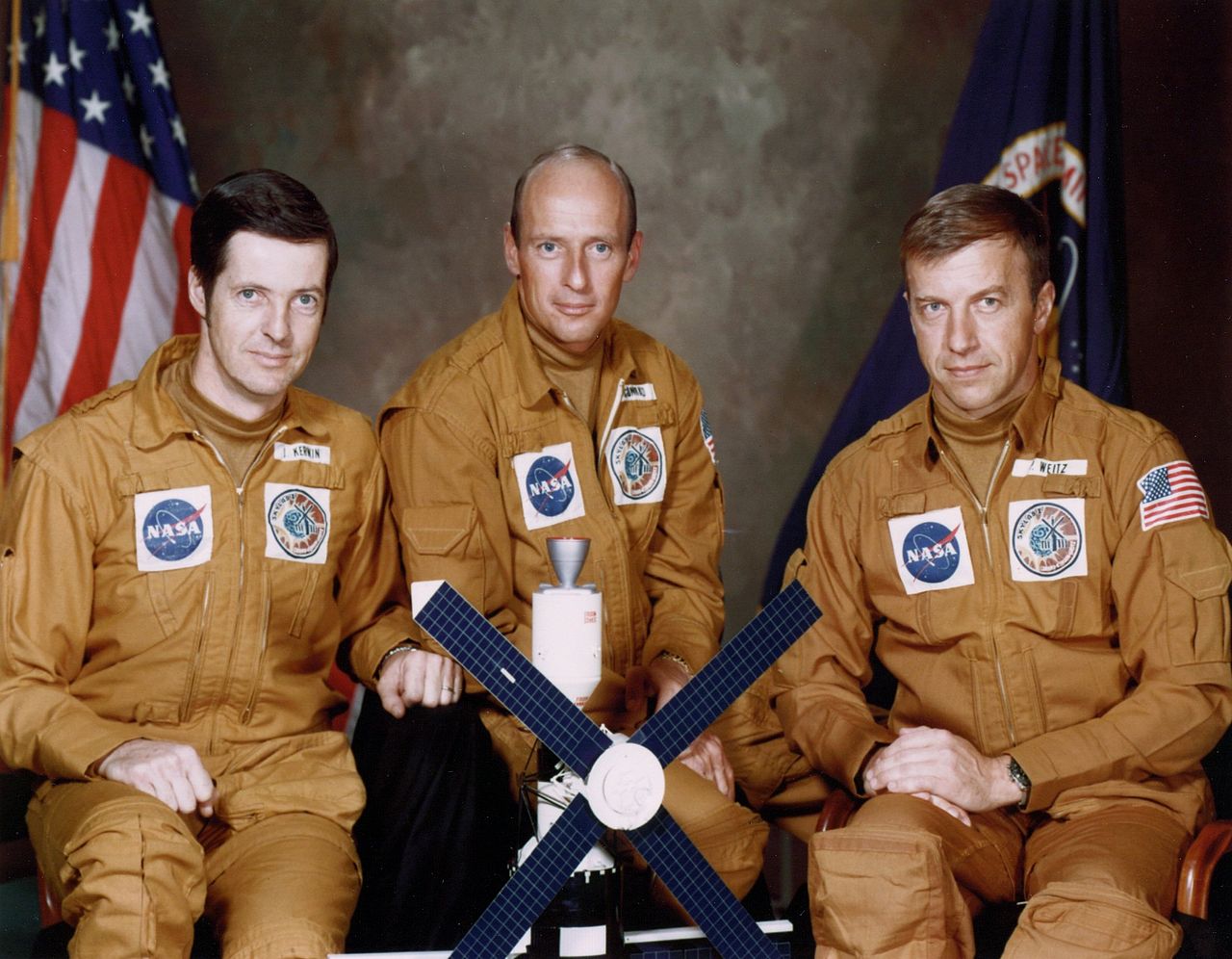
Paul Joseph Weitz, born July 25, 1932, is a veteran of the Skylab 2 mission and commander of the initial Space Shuttle Challenger flight. It was likely that he would have been chosen as Command Module Pilot for the Apollo 20 mission had it not been cancelled.
He's spent 793 hours in space. He performed an EVA during the Skylab mission lasting a little over an hour and a half.
May 25, 1973, Commander Charles “Pete” Conrad, Jr., Science
Pilot Joseph P. Kerwin and Pilot Paul J. Weitz blasted off in Skylab 2, the
first manned mission to Skylab, which had been launched 11 days prior. The unmanned portion was damaged during its
May 14 launch. The micrometeorite shield
and one of its primary solar arrays tore loose during lift-off. The other primary solar array, which was to
keep the space station cool, was jammed.
Skylab crew had to train on repairing techniques before they
could enter the station. Upon reaching the station, Weitz performed an EVA to
unjam the solar array while Kerwin held onto his legs. This did not work so they tried a hard dock
to Skylab, but this failed as well, since the lathes did not work.
After a total of eight attempts, Weitz and
Kerwin performed another EVA and were successful at docking by disassembling
parts of the station’s mechanism. Then
they deployed a collapsible parasol through the scientific airlock as a sunshade
to cool the interior to livable levels.
For almost a month, the crew continued to make repairs to
Skylab, conduct medical experiments and gather scientific data. They performed a final EVA to fix the stuck
solar panel and increasing electrical power to the station.
They spent four weeks in space and returned to Earth June
22.